
How Top 1% F&I Managers Handle VSC Objections (Full Training)
Vehicle Service Contract objections show up in almost every F&I office. Customers say, “It already has a warranty,” “I’m not keeping it that long,” “I’ll never use it,” or “I’ll take my chances.” On the surface, those sound like product objections. Most of the time, they are value objections.
That is where top F&I managers separate themselves from average producers. They do not argue, overtalk, or pressure the customer. They slow the conversation down, ask better questions, and connect the Vehicle Service Contract to how the customer actually plans to own and use the vehicle.
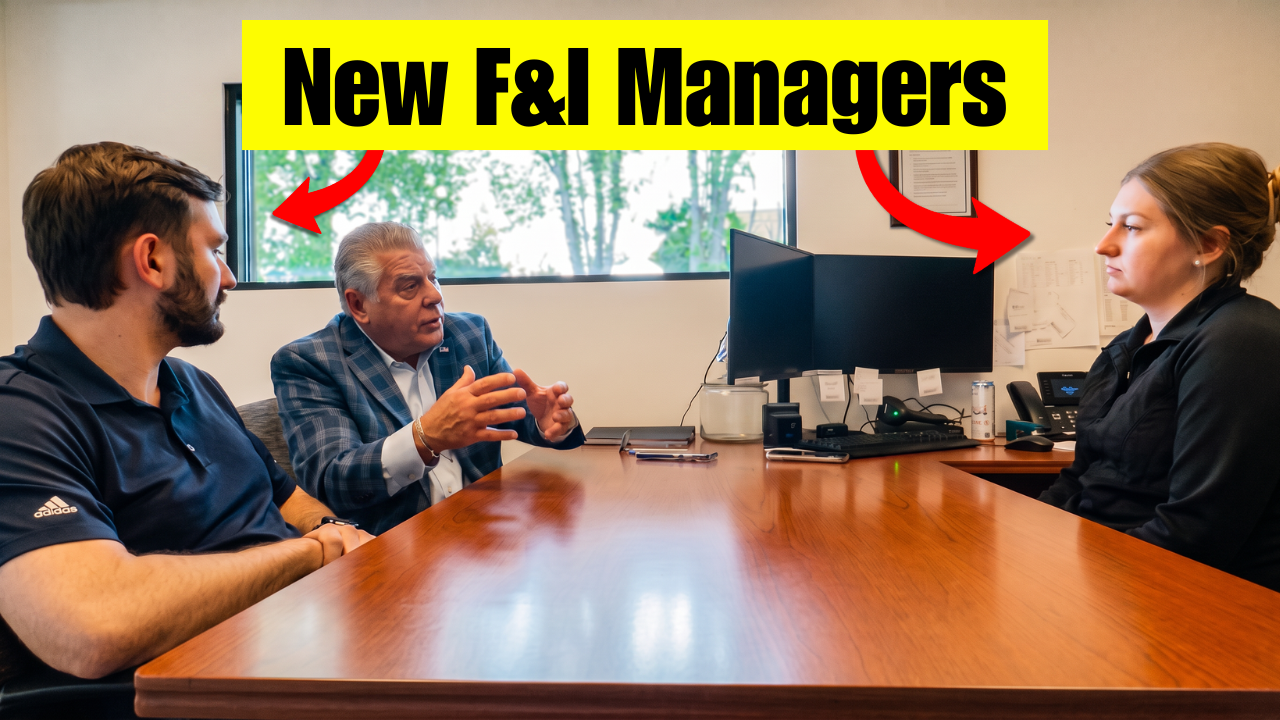
In this Product Prep training session, Gerry Gould works with James and Jade, two newer F&I managers, on a common challenge: helping customers understand the value of a VSC when they believe the factory warranty is enough. The top 1% F&I manager does not sell fear. They sell understanding, flexibility, protection, and peace of mind.
Key Takeaways
- Most VSC objections are about value, not the product itself. The customer does not yet see enough reason to justify the payment.
- The customer interview is the foundation of the close. How long they keep vehicles, how many miles they drive, and what they expect from the car should shape the presentation.
- Factory warranty objections require education around basic warranty coverage, powertrain coverage, technology risk, hybrid components, and long-term ownership exposure.
- Top F&I managers also know when to pivot. If the customer has no real interest in a service contract, the manager should move to a more relevant product.
Why VSC Objections Are So Common
A Vehicle Service Contract is valuable, but easy for customers to misunderstand. Many buyers think the factory warranty covers everything they need. Others rely on past experience and say, “This is my fifth Hyundai. I never had a problem.”
A customer may have owned reliable vehicles before, but that does not mean the next one will never have a mechanical or electrical issue. A customer may plan to trade in four years, but plans change. Vehicle prices may increase. Interest rates may move. A child may need the car for college.
That is why Gerry’s approach starts with dialogue. A weak F&I manager hears “no” and starts defending the product. A strong F&I manager hears “no” and uncovers the reason behind it. The goal is to help the customer make a better decision with better information.
Step One: Interview Before You Present
F&I managers need to interview customers before presenting products. This is how the manager learns what matters.
Ask how long they usually keep vehicles, how many miles they drive in a year, what they liked about their trade-in, what they disliked, where they service their vehicle, and why they are buying this vehicle now.
Those answers give the F&I manager direction. If a customer drives 15,000 miles a year and keeps vehicles until “the wheels fall off,” the VSC conversation should focus on long-term risk. If a customer drives 10,000 miles a year and trades every four years, the conversation should focus on flexibility, refund value, and the possibility of keeping the vehicle longer.
This makes the presentation feel personal. When the F&I manager says, “Based on what you shared with me,” the customer hears advice, not a canned pitch.
How To Handle “I’m Not Keeping The Car That Long”
Gerry’s strategy is to reframe the product as flexible protection.
If a customer says they will keep the car for four years and drive around 40,000 miles, the F&I manager can offer an 8-year, 80,000-mile service contract. If the customer trades around four years and 40,000 miles, they may receive a prorated refund on the unused portion. If they keep the vehicle longer, they still have protection.
A practical word track could be:
“Based on what you shared with me, you usually keep your vehicle around four years and drive about 40,000 miles. The reason I showed you the 8-year, 80,000-mile option is because if you trade around that time, you may get part of that money back. If you decide to keep it longer, you still have protection.”
This respects the customer’s plan while protecting them if the plan changes. The manager is not saying, “You are wrong.” They are saying, “Let’s protect both outcomes.”
How To Handle “It Already Has A Factory Warranty”
Customers often hear “factory warranty” and assume they are fully protected for the entire time they own the vehicle. The F&I manager’s job is to clarify the limits without attacking the manufacturer.
A strong response agrees that the vehicle has a good warranty, then explains the difference between basic coverage, powertrain coverage, and the items that may not be covered for the full ownership period. Many customers do not realize that sensors, modules, computers, screens, electrical components, and other high-tech parts may have different coverage limits.
Gerry also points out that manufacturers limit liability over time for a reason. A simple warranty timeline can help. Show the adjustment period, the basic warranty, the powertrain warranty, and where the VSC fits. This helps the customer see where their financial responsibility begins.
How To Handle “I’ll Never Use It”
Maybe they bought coverage before and never had a claim. Maybe their last five vehicles were reliable. Maybe they simply believe the brand will hold up.
Validate their experience, then reframe it.
A strong word track could be:
“I understand why you feel that way. If you had coverage before and never used it, I would probably have doubts too. But that also means you had peace of mind the entire time. The question is whether you want that same peace of mind this time, especially with more technology in this vehicle.”
This shifts the conversation from repair prediction to risk transfer. Nobody buys a VSC hoping to use it. They buy it so they are not exposed if something expensive happens later.
Use Technology To Build VSC Value
A stapler is simple. A cell phone is advanced. Most people expect the phone to fail, slow down, crack, or need replacement before the stapler does because technology has more components and changes faster.
Modern vehicles are similar. A customer may trust the brand, but the vehicle they are buying today is not the same as the one they bought ten years ago. Today’s vehicles may include screens, sensors, cameras, driver assistance systems, turbochargers, hybrid components, computer modules, and advanced electronics.
A practical way to say it is:
“You have owned this brand before and had a great experience. That is one of the reasons you bought another one. But would you agree that the technology in this vehicle is much greater than the one you traded? The more technology a vehicle has, the more important it is to understand how you are protected after the factory warranty changes.”
Gerry also uses the phone protection comparison. Many people protect a phone worth far less than their vehicle. If they protect a $1,000 or $2,000 phone, it makes sense to discuss protection on a $40,000, $50,000, or $60,000 vehicle.
How To Handle Hybrid And High-Tech Vehicle Objections
Customers may know that the battery has strong coverage, so they assume the entire vehicle is covered the way they need it to be.
Gerry teaches managers to explain that a hybrid can include both a mechanical drivetrain and an electric drivetrain. The customer may have strong coverage in certain areas, but the vehicle still contains many components that work together to make those systems function.
Gerry says, “Don’t be scared of what I’m saying,” because the manager should not make the vehicle sound like a problem. The goal is to educate the customer on complexity, mileage, ownership length, and protection.
How To Handle “I’ll Take My Chances”
“I’ll take my chances” sounds final, but Gerry sees it differently. When a customer says this, they are not necessarily saying they do not want the product. They are saying they are willing to assume the risk themselves.
A practical response is:
“When you say you’ll take your chances, what I hear is that you are willing to assume the risk yourself. My question is, why take that chance when you can lock in the cost now and transfer that risk?”
Do they want to carry the risk, or do they want to transfer it?
How To Handle Outside Advice
Customers may say Dave Ramsey told them not to buy a service contract. They may mention a friend, a relative, a mechanic, or a video they watched online. The mistake is to attack the source. A better strategy is to respect the comment and bring the decision back to the customer’s situation.
General advice does not always fit a specific buyer. A customer with a large emergency fund who pays cash and trades quickly may think differently than someone financing for 72 months, driving 18,000 miles a year, and depending on the vehicle for work and family. If that customer has a major repair later, the person who gave the advice probably will not pay the bill.
The Menu Process That Prevents Knee-Jerk Reactions
Menu flow matters. If an F&I manager asks, “Which option works best for you?” too early, many customers will automatically say no. It is human nature, just like when a salesperson in a store asks, “Can I help you?” and the customer says, “No, I’m just looking.”
The better process is to build value first. Explain each product in simple language. A Vehicle Service Contract helps pay for covered mechanical and electrical breakdowns. Tire and wheel helps with damaged tires and wheels. Key replacement helps with replacing or reprogramming keys. GAP may help in a total loss situation.
Then show the payment options clearly. The goal is not to force a column. The goal is to make the customer’s choices clear. After the presentation, ask, “Do you have any questions about what I just shared with you?” If they say no, then ask, “Which option works best for you?”
What To Do When The Customer Still Says No
Top F&I managers understand that. They do not take it personally, and they do not spend the entire delivery fighting for one product.
If the customer has no interest in the service contract, pivot to something more relevant. Maybe tire and wheel fits because the customer drives rough roads. Maybe GAP fits because of the finance structure. Maybe key replacement matters because modern keys are expensive.
Great F&I performance is not only about selling VSC. It is about finding value across the full menu while maintaining trust, compliance, and customer confidence.
Practical Advice For Better VSC Results
Stop treating every objection as a battle. A customer objection is often an invitation to clarify value. Use the customer interview, explain warranty coverage clearly, and build value before discussing payment. Customers rarely accept the money until they understand what the money protects.
Stay compliant and professional. Do not exaggerate coverage. Do not scare the customer. Explain risk clearly and let the customer make an informed decision. If VSC is not connecting, pivot to a product that matters more to the customer.
FAQs
1) What is the best way to handle “I already have a warranty”?
Agree with the customer, then explain the difference between factory coverage, powertrain coverage, and long-term ownership risk.
2) What should I say when the customer is not keeping the car long?
Use their ownership plan. Explain refund flexibility if they trade early and continued protection if they keep it longer.
3) How do I respond when a customer says they will never use it?
Validate their experience. Then explain that unused coverage still gave them peace of mind.
4) How can VSC training improve PVR?
Better objection handling creates more opportunities for product enrollment and stronger value-based presentations.
Conclusion
The best F&I managers do not win VSC objections by arguing. They win by asking better questions, listening closely, explaining coverage clearly, and connecting the product to the customer’s real ownership plan.
Gerry Gould’s training with James and Jade shows that objection handling is not about memorizing one perfect line. It is about building a process. Interview the customer. Understand their mileage and ownership habits. Explain the factory warranty. Show the role of technology. Present the menu clearly. Ask good questions. Then help the customer make an informed decision.
For dealerships that want stronger VSC penetration, higher PVR, better compliance, and more confident F&I managers, Product Prep provides training that turns everyday objections into better conversations. That is how top 1% F&I managers handle VSC objections. They educate, personalize, and lead with value.
By the way, you’re invited to check out our world-class F&I training program where the average F&I Manager increases their PVR by over 30% in the first month. You’ll have access to 100+ hours of training videos personalized to your weaknesses. Plus, you get exclusive access to see Gerry Gould LIVE twice per month to ensure you continue to grow your skillset and income. Come join a community of the top F&I Managers in the country and the #1 F&I Training in the world. For $149 you can pay that off with one extra deal we’ll personally teach you in the first week of training.