
How He Became A Successful F&I Manager
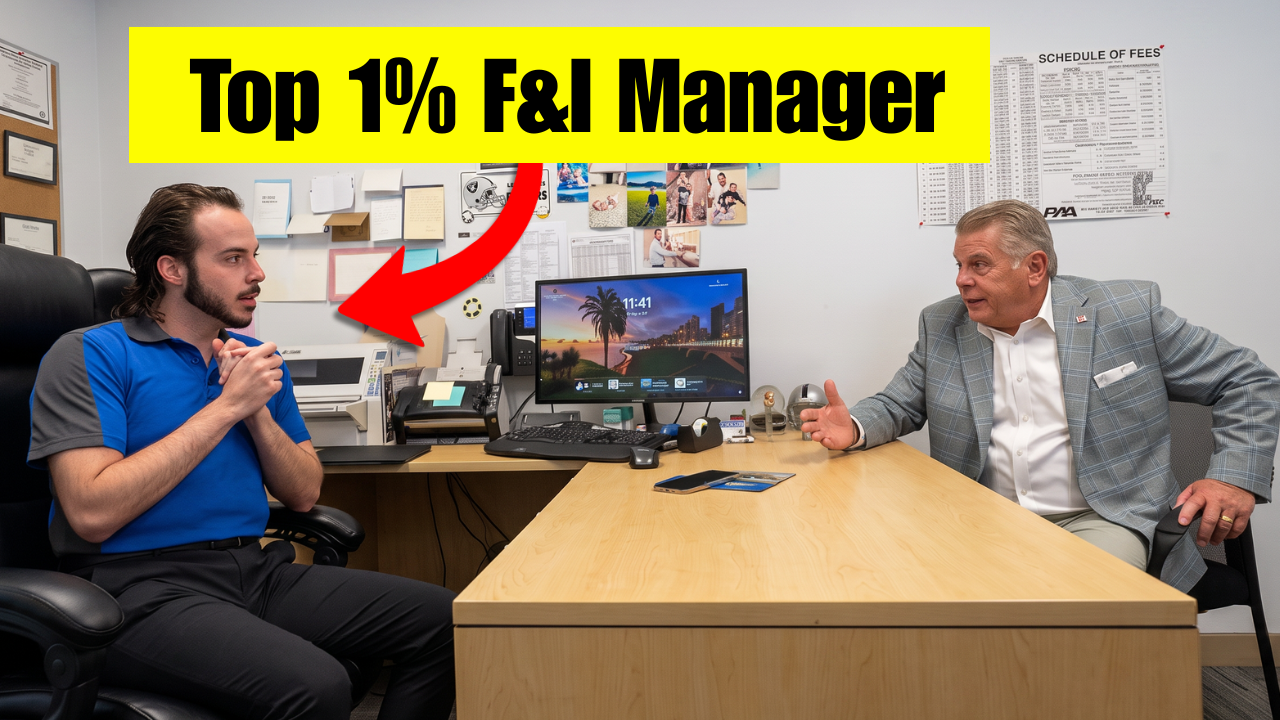
What does it really take to become a successful F&I manager?
For many salespeople, F&I looks like the next logical step. You sell cars, build trust, work deals, understand customers, and perform well on the showroom floor. Then you move into the F&I office and realize quickly that this is a different game.
That is what happened with Anthony. In just two years and six days, he went from a top sales consultant to a strong F&I manager who kept improving month after month. His story matters because it shows what real growth looks like inside a dealership. It is built on preparation, customer connection, compliance discipline, self-review, and a constant desire to get better.
Gerry Gould uses Anthony’s path to show new and aspiring F&I managers what real improvement looks like in the store.
Key Takeaways
- Anthony learned that sales and F&I are not the same role.
- He improved by getting involved earlier in the customer’s deal.
- He kept his structure consistent while personalizing the message based on the customer.
- He refused to settle, even when his results improved.
From Sales Consultant To F&I Manager
Anthony did not enter F&I without automotive experience. He was already a strong sales consultant and one of the top performers at his dealership. That helped him understand customers, objections, vehicles, and the rhythm of the showroom.
But the move into F&I was still a shock.
On the sales floor, a salesperson may have 45 minutes or more to build rapport. In F&I, Anthony explained that he may only have 10 to 15 minutes to earn trust, present products, protect compliance, and help the dealership generate profit.
A great salesperson can struggle in F&I because the skill set is different. F&I requires sharper listening, faster rapport, stronger product knowledge, and a clear process. It also requires discipline behind the scenes. Funding, paperwork, voicemails, lender requirements, deal structure, and compliance all matter.
That is why F&I training is not optional for long-term success. The office is not just a place to sell products. It is one of the most important profit and compliance centers in the dealership.
Why F&I Is A Different Kind Of Selling
Anthony made an important point: selling a Honda is not the same as selling protection products.
When a customer buys a Honda or Acura, they often believe they are buying reliability. That belief can create resistance in the F&I office. The customer may think, “Why would I need a service contract if this vehicle is known for lasting a long time?”
This is where many new F&I managers make a mistake. They try to push harder instead of explaining better.
A successful F&I manager does not attack the customer’s belief. They reframe the conversation. Reliability does not remove ownership risk. Even reliable vehicles can have expensive technology, sensors, touchscreens, wiring concerns, tires, wheels, and long-term wear. The conversation is not about whether the vehicle is good. It is about what could happen during ownership and how the customer wants to handle that risk.
Product Prep teaches F&I managers how to communicate value in a way customers can understand. It is about knowing the product, understanding the customer, and presenting the right protection in the right way.
Why F&I Profit Matters More Than Ever
Anthony also pointed out a reality every dealership leader understands: front-end profit is under pressure. Customers shop online, compare vehicles, and expect transparency before they ever step into the showroom.
That makes F&I performance even more important. A strong F&I department can improve PVR, support profitability, and stabilize the dealership when vehicle margins get tighter. But this only happens when F&I is trained, disciplined, aligned with sales, and involved before the customer reaches the office.
The First Challenge: Building Trust Fast
One of Anthony’s biggest challenges was learning how to build trust quickly.
Customers often enter the F&I office with their guard up. Some already believe they are about to be sold something they do not need because of bad advertising, online complaints, or poor sales experiences.
Anthony does not ignore that skepticism. He acknowledges it. Instead of defending the product too aggressively, he meets the customer where they are. Then he explains the value in a practical way.
For example, he may tell a customer that he does not buy protection on every small item either. But after working with service departments and seeing real repair costs, he understands why vehicle protection can make sense.
Trust grows when customers feel the F&I manager is on their side. The goal is not to force every product onto every customer. The goal is to match the right protection to the way the customer plans to own, drive, and use the vehicle.
The Power Of Early F&I Involvement
One of the most important lessons in Anthony’s journey was early involvement.
He admitted that there was a time when he stopped introducing himself to customers early in the deal. When he stopped, his PVR dropped. That is a powerful lesson for every F&I manager.
Early involvement does not have to be complicated. Anthony talked about finding simple reasons to meet the customer. Maybe he walks out to make a copy of the plate, introduces himself early, or asks how they plan to use the vehicle.
Those small conversations matter. They help the customer see the F&I manager as a person instead of a stranger waiting in an office. They also give the F&I manager valuable information that can shape the presentation later.
If a customer has five grandkids, drives 20,000 miles a year, and uses the vehicle for family travel, that matters. Tires, wheels, rips, stains, wear, mileage, and long-term protection become more relevant. The F&I manager can connect the product to the customer’s life instead of presenting it as a generic add-on.
Structure Stays The Same, But The Message Changes
Many F&I managers are taught to do the same thing every time. That advice is partly correct.
The structure should remain consistent. A consistent process supports compliance, creates professionalism, and protects the dealership. Customers should receive a clear, fair, and complete presentation. The F&I manager should not randomly skip steps or present products carelessly.
But Anthony makes an important distinction: the structure stays the same, while the message changes.
A customer who drives 8,000 miles a year and trades every three years does not need the same conversation as a customer who keeps vehicles for 10 years and drives across the country with family. The menu may be structured the same way, but the value points should be different.
This is what Gerry often teaches around attunement. You have to understand the customer’s perspective. What do they care about? What risks are they taking? What matters to their family, budget, vehicle, or lifestyle?
When the F&I manager gets inside the customer’s perspective, the customer is more likely to listen because the conversation is about them, not just the product.
How Anthony Handles Cash Buyers
Cash buyers were difficult for Anthony at first. That is common for many F&I managers.
A cash buyer can feel like someone who already made up their mind. They do not need financing, they may want to move quickly, and they may believe there is nothing left to discuss.
Anthony learned to change his mindset.
If someone can write a check for a $50,000 vehicle, they likely care about protecting that investment. When positioned properly, protection products can feel logical instead of unnecessary. The conversation becomes simple: you just made a major purchase, and for a small percentage of that investment, you can protect yourself from certain ownership risks.
That does not mean every cash buyer buys everything. It means the F&I manager should not assume there is no opportunity. Cash buyers still own the vehicle. They still face repair risk, tire and wheel damage, interior wear, and technology costs.
This is where Product Prep training can help. Gerry teaches practical word tracks and deal strategies that help F&I managers approach cash buyers with confidence. The right language can turn a difficult deal into a profitable and customer-focused conversation.
Turning Objections Into Risk Transfer Conversations
One of Anthony’s strongest points was how he explains service contracts.
He does not just say, “This warranty is a good idea.” He explains risk transfer.
If a customer faces a $2,600 or $2,800 repair, they either carry that risk personally or transfer certain covered risks to the warranty company. That is a much clearer way to explain the value.
Customers understand risk when it is made practical. A touchscreen can fail. A wiring issue can be expensive. Technology in modern vehicles is not cheap.
The F&I manager’s job is to help the customer make an informed decision. That requires simple language, real examples, and a calm presentation. It also helps with compliance because the customer should understand what the product does, what it does not do, and why it may fit their ownership plan.
Strong F&I managers sell with clarity. Weak ones rely on pressure.
The Habit That Made Anthony Better Every Month
Anthony’s success did not happen because of one good word track. It happened because he kept reviewing himself.
After a deal, he would think through what happened. Did he answer the objection the right way? Did he miss a chance to build value? Did he connect the product to the customer’s actual situation? Should he have handled the conversation differently?
That self-review is one of the biggest differences between average and elite F&I managers.
Numbers matter, but numbers only tell part of the story. To truly improve, managers also need to study behavior.
Anthony’s mindset is simple: he never wants to stay stagnant. He wants to improve for his career, his dealership, and his family. That kind of personal drive can be strengthened through the right training environment.
Why “I’ve Arrived” Is The Wrong Mindset
One of Anthony’s most powerful statements was that he will never say he has arrived.
Even if he reaches $2,500 per car, he still wants to improve. That attitude matters because F&I is always changing. Products change. Customers change. Lenders change. Compliance expectations change. Dealership processes change.
The F&I manager who thinks they already know everything becomes vulnerable. The best managers stay coachable. They continue watching training, attending live sessions, asking questions, and refining their process. They do not treat training as something only new people need. They treat it as part of staying sharp.
That is one reason Product Prep Live is valuable for dealerships. It gives managers access to ongoing coaching, not just one-time training. Live sessions with Gerry Gould help F&I managers talk through real objections, current deal challenges, compliance concerns, and presentation improvements.
Practical Advice For New F&I Managers
If you are new to F&I, Anthony’s journey gives you a clear roadmap.
First, respect the role. F&I is not just sales with a different desk. It impacts profit, compliance, funding, customer experience, and dealership efficiency.
Second, get involved early. Introduce yourself, gather information, and build familiarity before the presentation.
Third, keep your structure consistent. A strong process protects you and the dealership. But once the structure is in place, personalize the conversation based on what you learned.
Fourth, review every deal. Do not only celebrate wins or complain about losses. Study both. Ask what worked, what failed, and what should change next time.
Finally, stay coachable. The moment you think you have arrived is the moment your growth starts slowing down.
FAQs
1) How long does it take to become a successful F&I manager?
Anthony made major progress in two years, but there is no fixed timeline. Success depends on training, effort, coaching, dealership support, and how willing the manager is to review their own performance.
2) Is being a great salesperson enough to succeed in F&I?
No. Sales experience helps, but F&I requires different skills. You need compliance awareness, product knowledge, funding discipline, lender understanding, menu presentation ability, and fast trust-building.
3) How can a new F&I manager improve PVR?
Start by getting involved earlier in the deal. Gather better customer information, personalize the presentation, use a consistent structure, and review missed opportunities.
4) Why is early involvement so important?
Early involvement creates trust before the customer enters the F&I office. It also gives the manager information that can make the product presentation more relevant and personal.
5) How should F&I managers handle skeptical customers?
Acknowledge the concern first. Do not argue. Explain risk clearly, use real-world examples, and connect the product to the customer’s ownership plan.
Conclusion
Anthony’s story shows how he became a successful F&I manager in just two years by doing the work most people avoid.
He respected the role. He learned that F&I is different from sales. He got involved earlier. He studied his customers. He kept his structure consistent while making the message personal. He reviewed his deals and refused to settle for average.
For F&I managers, salespeople who want to move up, and dealership leaders who want stronger performance, the lesson is clear. Success in F&I is not about winging it. It is about training, discipline, customer connection, compliance, and constant improvement.
If your dealership wants to increase PVR, improve consistency, and build stronger F&I professionals, Product Prep gives your team the tools, coaching, and structure to grow.
By the way, you’re invited to check out our world-class F&I training program where the average F&I Manager increases their PVR by over 30% in the first month. You’ll have access to 100+ hours of training videos personalized to your weaknesses. Plus, you get exclusive access to see Gerry Gould LIVE twice per month to ensure you continue to grow your skillset and income. Come join a community of the top F&I Managers in the country and the #1 F&I Training in the world. For $149 you can pay that off with one extra deal we’ll personally teach you in the first week of training.