
CDK Training for New F&I Managers: What to Check First
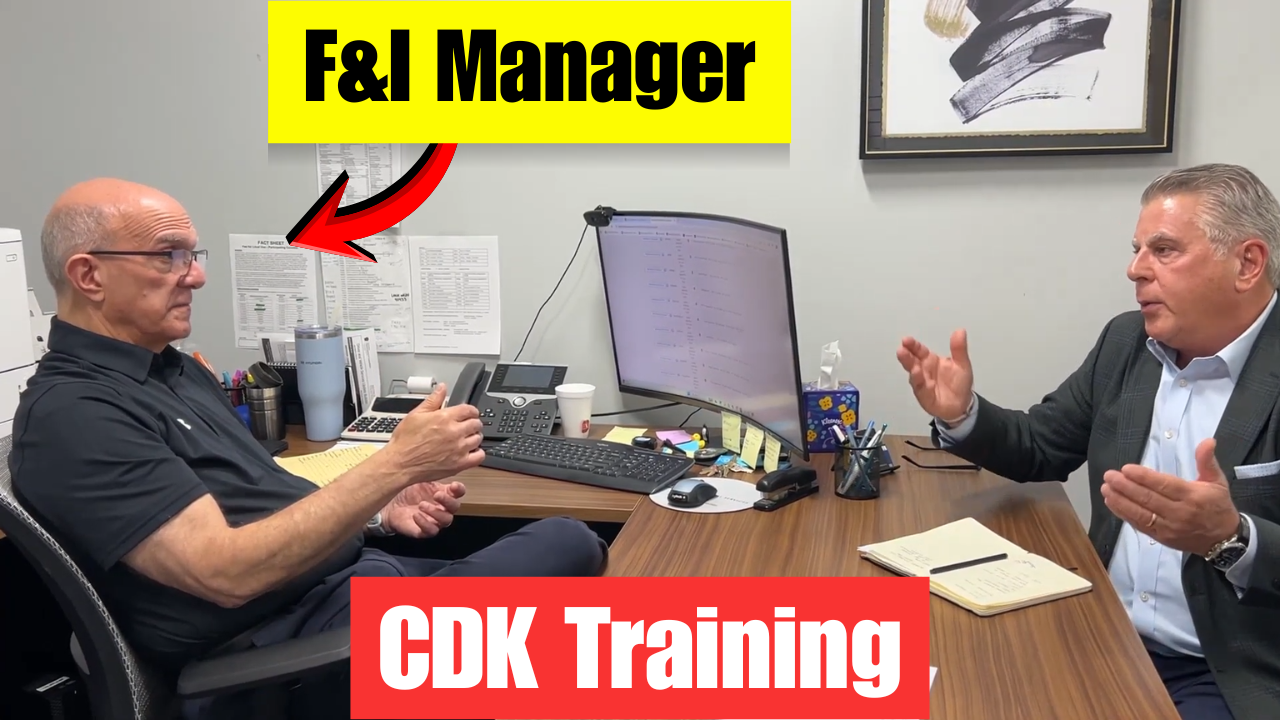
What should a new F&I Manager check first when a deal gets pushed into CDK?
That question creates confusion for a lot of people entering the finance office for the first time. Many new F&I Managers spend hours learning menu presentations, objection handling, compliance basics, and product knowledge, but very few receive detailed hands-on CDK or DMS training before sitting behind the desk. Then reality hits fast. The first deal gets pushed over from the CRM, the customer is waiting, the sales manager wants the deal done quickly, and suddenly the finance office becomes the final checkpoint for every number, every form, every lender requirement, and every compliance document.
That is where many new F&I Managers begin to understand the real pressure of the job.
During a Product Prep discussion with Gerry Gould and dealership professionals, one of the biggest takeaways was simple but powerful: once the deal reaches F&I, the finance manager becomes responsible for verifying everything. The sales manager may structure the deal in the CRM, but the F&I Manager must ensure the information is correct before contracts are printed, lenders are submitted, and state paperwork is finalized.
This is why CDK training matters so much.
The finance office is not just about selling products. It is about accuracy, process, compliance, and organization. One missed detail can delay funding, create state paperwork problems, damage customer satisfaction, or cause compliance issues that hurt the dealership later.
For new F&I Managers, learning where to look first inside CDK can dramatically improve speed, confidence, and efficiency behind the desk. In this article, we are going to break down exactly what new F&I Managers should check first, why each screen matters, and how Product Prep training helps simplify one of the most overwhelming parts of the automotive business.
Key Takeaways
- New F&I Managers should always start with the deal screen to verify all figures and math.
- Customer numbers and deal numbers serve different purposes and both must be checked carefully.
- Vehicle, trade, miscellaneous, and customer screens all affect lender approval, compliance, and funding accuracy.
- A regimented process inside CDK helps reduce mistakes, improve compliance, and speed up deal flow.
Why CDK Training Matters for New F&I Managers
One of the biggest misconceptions about becoming an F&I Manager is that the job is mainly about product presentation and closing. Those skills matter, but they are only part of the role.
The real challenge begins when the deal reaches the finance office.
A new F&I Manager quickly realizes that CDK is not just software. It becomes the control center for the entire transaction. Every number, every lender detail, every tax calculation, every compliance form, and every customer record eventually flows through the DMS.
This is why dealerships that invest in real DMS training create stronger finance departments.
Many new F&I Managers come from sales or sales management positions. They understand customers. They know how to structure payments. Some are excellent communicators. But once they move into F&I, they discover an entirely different world involving lender portals, deal jackets, state paperwork, tax calculations, compliance forms, registration requirements, and customer verification.
That learning curve can feel overwhelming.
The conversation from Product Prep highlighted an important point that many dealerships overlook. Customers and salespeople often wonder why F&I takes so long. From the outside, it may seem like the finance office is simply printing paperwork. In reality, the F&I Manager is balancing requirements from multiple entities all at the same time:
- The dealership
- The manufacturer
- The lender
- The state
- Compliance regulations
Each one has its own rules, paperwork, and approval requirements.
That is why the best F&I Managers become extremely regimented with their process. They follow the same order every deal because consistency reduces mistakes.
Without a strong CDK process, errors start stacking up fast. A missed rebate, incorrect tax rate, wrong customer spelling, or incorrect lender assignment can create funding delays and compliance problems that affect the entire dealership.
This is where Product Prep training stands out compared to many generic automotive courses.
Most training programs focus heavily on sales psychology and product presentation. Product Prep goes deeper into the operational side of the business. Gerry Gould and the Product Prep team regularly break down real dealership workflows, helping managers understand not just how to sell, but how to operate efficiently behind the desk.
That practical training becomes extremely valuable for new F&I Managers trying to build confidence inside the office.
Step 1: Start With the Deal Screen
Verify the Math First
One of the strongest lessons from the Product Prep discussion was simple: always start with the deal screen.
Before checking customer information, before reviewing products, before printing contracts, the F&I Manager should verify the math.
The deal screen becomes the foundation for everything else.
New F&I Managers should review:
- Selling price
- Taxes
- Rebates
- Dealer fees
- Tax credits
- Down payment
- Payoff information
- Amount financed
- Payment structure
Why does this matter so much?
Because the deal is usually structured in the CRM before it reaches the DMS. That means the sales desk may have entered the figures originally. Once the deal gets pushed into CDK, the finance office becomes responsible for making sure everything transferred correctly.
As discussed during the Product Prep session, experienced finance managers know not to trust the push automatically. Every line must be checked.
This becomes especially important in areas where tax rates vary by location. A customer living in one township may have a different tax rate than someone living only a few miles away. A small mistake here can create funding problems later.
Experienced F&I Managers develop the habit of slowing down long enough to verify the numbers carefully before moving forward.
That habit protects both the dealership and the customer.
Match the CRM Push Against the DMS
The transcript also highlighted the relationship between the CRM and the DMS.
The deal may begin in systems like VinSolutions or another CRM platform. The sales manager structures the deal there, then pushes it into CDK. Once pushed over, the finance manager cleans up the deal and finalizes it.
This is where many new F&I Managers make mistakes.
They assume the information transferred perfectly.
Experienced finance managers know better.
One missing rebate, wrong payoff, incorrect fee, or lender mismatch can create major issues later. That is why the deal screen should always be the first checkpoint before moving into the rest of the process.
Step 2: Understand Customer Number vs. Deal Number
What Is a Customer Number?
One of the most educational parts of the Product Prep discussion involved customer numbers and deal numbers.
New F&I Managers often confuse the two.
The customer number stays connected to the individual customer. If the customer bought a vehicle years ago or serviced at the dealership previously, they may already exist in the system.
This helps populate customer information automatically.
That can save time, but it also creates risk if the information is outdated.
What Is a Deal Number?
The deal number is tied specifically to that transaction.
A customer may have purchased several vehicles over the years while maintaining the same customer number, but every individual deal requires its own deal number.
Understanding this difference helps prevent confusion during the deal-building process.
Why Matching Customer Information Matters
Even if the customer information auto-populates, experienced F&I Managers still verify everything carefully.
People move.
Addresses change.
Insurance changes.
Phone numbers change.
Even something as small as a missing middle initial or incorrect ZIP code can create lender issues or contract delays.
This is why successful F&I Managers rely on supporting documents such as:
- Driver’s license
- Insurance card
- Credit application
- Registration information
The finance office becomes the final verification point before contracts become official.
Step 3: Check the Vehicle Screen
Confirm the Correct Vehicle
After verifying the math, many experienced F&I Managers move directly to the vehicle screen.
This step helps confirm:
- VIN number
- Mileage
- Stock number
- Vehicle model
- Selling unit
A simple mistake here can affect the entire deal.
Imagine funding a contract tied to the wrong VIN or incorrect mileage. That creates lender problems, title issues, warranty complications, and customer frustration.
Experienced F&I Managers understand that every screen matters because every screen affects another part of the process later.
Why Vehicle Accuracy Matters
The vehicle screen influences:
- Bank contracts
- Registration paperwork
- Warranty enrollment
- Manufacturer reporting
- Insurance verification
This is another reason why F&I cannot rush blindly through the process just because customers want shorter wait times.
Accuracy matters more than speed.
The best finance managers learn how to improve both.
Step 4: Review the Trade Screen
Trade information creates another layer of complexity inside the deal.
The F&I Manager must confirm:
- Trade VIN
- Payoff balance
- Ownership details
- Mileage
- Appraisal information
- Stock assignment
Trade mistakes can delay funding quickly.
If the payoff is incorrect or ownership information does not match, lenders may hold contracts until the issue is corrected.
This is one reason why strong communication between sales management and F&I matters so much.
The cleaner the deal arrives to finance, the faster the transaction moves.
Step 5: Review the Miscellaneous Screen
The miscellaneous screen may not sound exciting, but it contains critical information.
This often includes:
- Plate details
- Insurance information
- Store identification
- Dealer-specific information
One important point discussed during the Product Prep conversation was that CDK originated from an accounting-focused structure rather than a sales-focused system.
That means important information may not always appear where new users expect it.
This is why successful F&I Managers follow the same process every deal instead of jumping randomly between screens.
Consistency creates fewer mistakes.
Step 6: Review the Customer Screen Last
Many new F&I Managers assume the customer screen should come first.
Some experienced managers actually review it later after verifying the structure of the deal.
At this stage, the finance manager carefully confirms:
- Name spelling
- Address
- ZIP code
- License details
- Insurance information
- Customer identifiers
Why is this so important?
Because lenders are extremely sensitive to inconsistencies.
Even small mismatches can create delays.
If the customer’s license says one thing and the contract says another, the lender may request corrections before funding the deal.
Experienced F&I Managers understand that accuracy upfront saves time later.
Step 7: Understand In-State vs. Out-of-State Deals
Out-of-state deals create an entirely different level of complexity.
Taxes, registration requirements, title processes, and fees may change dramatically depending on where the customer lives.
New F&I Managers often underestimate how much additional work these deals require.
According to the Product Prep discussion, many dealerships use additional tools or third-party programs specifically to help process out-of-state transactions correctly.
This becomes critical because incorrect taxes or registration paperwork can delay delivery and funding.
New F&I Managers should double-check:
- State tax rates
- Registration requirements
- Title procedures
- Dealer fees
- Lender requirements
- Compliance documentation
The more experience an F&I Manager gains, the more comfortable they become navigating these situations.
Step 8: Know Where Forms Come From
One of the most eye-opening parts of the discussion involved paperwork itself.
Many people assume all forms simply print automatically.
The reality is more complicated.
Some documents print through laser printers.
Others still require impact printers depending on state requirements.
Certain lenders may require specific forms programmed into the system.
This creates another layer of complexity inside the finance office.
One of the best explanations from the transcript broke the deal jacket into four categories:
- Manufacturer paperwork
- State paperwork
- Lender paperwork
- Dealership paperwork
That explanation helps new F&I Managers understand why the finance process feels so detailed.
The F&I office is balancing multiple legal and operational requirements all at once.
Step 9: Follow the Compliance Checklist Every Time
Compliance may not be the exciting part of F&I, but it is one of the most important.
Successful F&I Managers become highly regimented because consistency protects the dealership.
Some of the key compliance documents discussed included:
- OFAC
- Risk-Based Pricing Notice
- Adverse Action
- Red Flags
- Safeguards requirements
Dealerships also face regular audits.
That means paperwork accuracy and compliance consistency cannot be optional.
This is another area where Product Prep training creates value.
Many generic sales courses spend little time discussing operational compliance realities. Product Prep regularly addresses the real responsibilities finance managers face every day behind the desk.
That practical focus helps managers reduce costly mistakes.
Why F&I Takes Longer Than Customers Think
One of the strongest themes from the Product Prep conversation was helping people understand why F&I takes time.
Customers often think the finance office simply prints paperwork and sells products.
In reality, the finance manager is verifying information for multiple entities at once while handling one deal after another throughout the day.
A single deal may involve:
- Lender approval
- State registration
- Manufacturer requirements
- Dealership documentation
- Compliance verification
- Product enrollment
- Contract printing
That workload increases dramatically on busy weekends.
This is why organized systems matter so much.
The best F&I Managers do not become faster because they skip steps.
They become faster because they master a consistent process.
FAQs
1) What should a new F&I Manager check first in CDK?
The deal screen should always be checked first. Verify the math, taxes, rebates, fees, payoffs, and lender structure before moving forward.
2) Why is CDK accuracy so important?
CDK controls lender contracts, state paperwork, compliance forms, and funding documentation. Errors inside the DMS can delay funding and create compliance issues.
3) What is the difference between a customer number and a deal number?
A customer number stays attached to the customer over time, while the deal number belongs only to that specific transaction.
4) Why does F&I take so long at dealerships?
F&I involves lender approvals, compliance checks, state paperwork, customer verification, product enrollment, and contract preparation. Multiple entities are involved in every deal.
5) What compliance forms should new F&I Managers know?
Important forms include OFAC, Risk-Based Pricing Notices, Adverse Action notices, Red Flags compliance, and Safeguards Rule documentation.
Conclusion
CDK training is one of the most overlooked parts of preparing new F&I Managers for success.
Many people entering the finance office understand sales and customer interaction, but the operational side of the role requires a completely different level of discipline, organization, and accuracy.
The deal screen, customer verification, vehicle information, trade details, lender setup, compliance forms, and paperwork process all matter because the F&I office becomes the final checkpoint before the deal leaves the dealership.
That responsibility is why experienced finance managers become so regimented with their process.
The stronger the process, the cleaner the deal.
The cleaner the deal, the smoother the funding, compliance, and customer experience become.
For dealerships looking to strengthen their finance department, reduce mistakes, and develop confident new managers, proper CDK training is no longer optional. It is essential.
By the way, you’re invited to check out our world-class F&I training program where the average F&I Manager increases their PVR by over 30% in the first month. You’ll have access to 100+ hours of training videos personalized to your weaknesses. Plus, you get exclusive access to see Gerry Gould LIVE twice per month to ensure you continue to grow your skillset and income. Come join a community of the top F&I Managers in the country and the #1 F&I Training in the world. For $149 you can pay that off with one extra deal we’ll personally teach you in the first week of training.