
Car Sales Training: 3 Keys To Selling More Cars
Have you ever wondered why two salespeople can work at the same dealership, sell the same vehicles, and have access to the same inventory, yet one consistently outsells the other?
It is rarely because they have lower prices or better inventory. More often, the difference comes down to their sales process, communication skills, and ability to connect with customers before the competition does.
Today's customers shop differently than they did even a few years ago. Before they ever walk into a showroom, they have already compared vehicles, watched reviews on YouTube, read customer testimonials, checked dealership ratings, and requested pricing from multiple stores. By the time they contact a dealership, they are already several steps into their buying journey.
That means the traditional approach of greeting customers with generic questions or waiting until they arrive to build value simply does not work anymore.
According to Gerry Gould, founder of Product Prep and one of the automotive industry's most respected sales and finance trainers, the best salespeople understand one simple principle: you must meet customers where they are, not where you wish they were.
Whether your first interaction happens through an online lead, a text message, a phone call, or face to face in the showroom, every conversation should move the customer closer to making a confident buying decision.
That is exactly what this guide is about.
In this article, you'll learn the three keys to selling more cars, how modern customers make purchasing decisions, and the proven sales techniques Gerry Gould teaches dealerships across North America to help sales consultants increase appointments, improve closing ratios, and create customers who come back again and again.
Key Takeaways
Before diving into the process, here are the biggest lessons every salesperson should remember:
- Most vehicle purchases begin online long before customers visit a dealership.
- Great salespeople discover customer motivations before presenting vehicles.
- Personalized communication builds trust faster than templates.
- Strong walkarounds and test drives create value that price alone cannot replace.
Why Car Sales Training Matters More Than Ever
The automotive industry has changed dramatically.
Years ago, customers visited several dealerships before narrowing down their choices. Today, most of that research happens online before they ever step into the showroom.
Gerry Gould estimates that 80 to 90 percent of vehicle purchases are already taking shape before the customer arrives. They know the vehicles, trim levels, competitor pricing, reviews, and may have already contacted multiple dealerships through email, text, chat, or phone.
By the time they reach you, they are not just shopping for a vehicle. They are deciding who deserves their business.
That is why modern sales success starts before the customer walks through the door. It begins with fast responses, better questions, useful information, and professionalism from the first interaction.
Many dealerships still lose deals because of outdated habits like generic emails, unanswered questions, unprepared vehicles, and disorganized appointments. These mistakes make customers feel like another dealership values their business more.
Car sales training helps prevent that by giving sales consultants a repeatable process. Instead of guessing what to say, they learn how to uncover customer motivations, build value before price, and create an experience customers remember.
The result is more appointments, stronger relationships, better customer satisfaction, and ultimately, more vehicles sold.
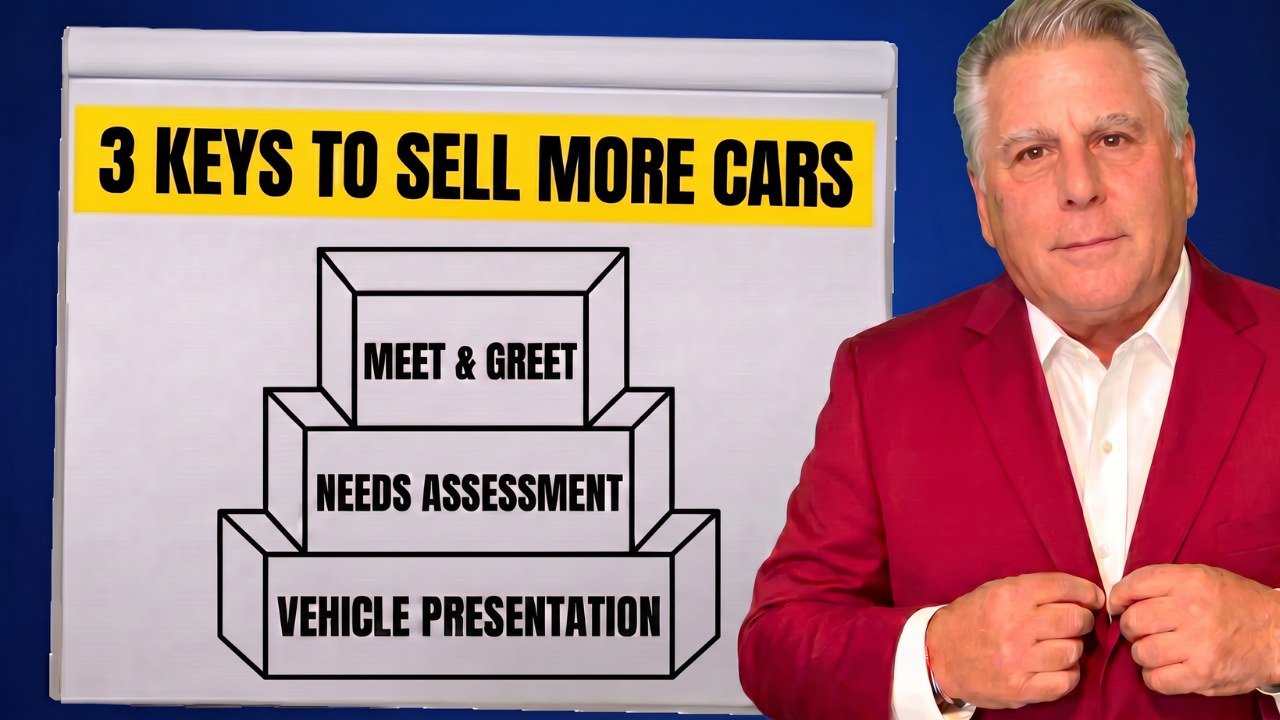
The 3 Keys To Selling More Cars
Many salespeople believe selling a car is primarily about presenting the vehicle.
Gerry Gould teaches something different.
Before customers buy the vehicle, they buy into three things:
- The salesperson.
- The dealership.
- The vehicle.
Miss any one of those, and the sale becomes much more difficult.
Let's look at each one.
Key 1: Sell Yourself First
Customers decide surprisingly quickly whether they trust someone.
Long before discussing payments or trade values, they are evaluating something much simpler.
"Do I want to work with this person?"
That first impression begins immediately.
Your appearance.
Your attitude.
Your enthusiasm.
Your professionalism.
Even your tone of voice over the phone.
Gerry often reminds salespeople that customers can hear a smile.
It sounds simple, but enthusiasm carries through every conversation.
That is why many phone training experts recommend keeping a mirror near your workstation. When you smile naturally, your voice becomes warmer, more energetic, and more welcoming.
Customers notice.
Stop Asking "Can I Help You?"
One of Gerry's biggest recommendations is eliminating one of the oldest greetings in automotive retail.
"Can I help you?"
The problem is not the question itself.
The problem is that customers already know the answer.
"I'm just looking."
Now the conversation has reached a dead end before it has even started.
Instead, open the door to a real conversation.
Examples include:
- Welcome to our dealership. Are you here for sales or service?
- What would you like to accomplish today?
- Have you spoken with anyone here before?
- Where would you like to start?
These questions feel natural while encouraging customers to share information.
Every answer provides another opportunity to understand what matters most.
Build Rapport Before Selling
Great salespeople do not immediately begin pitching vehicles.
They first establish a connection.
Sometimes that connection comes from noticing a sports jersey.
Sometimes it comes from talking about a customer's family.
Sometimes it comes from discussing the vehicle they currently drive.
Small conversations create comfort.
Comfort creates trust.
Trust makes selling much easier.
Imagine two customers walking into separate dealerships.
The first salesperson immediately launches into rebates, monthly payments, and inventory.
The second spends three minutes learning why the customer started shopping, what they currently drive, and what they hope to improve.
Which salesperson is more likely to earn the customer's confidence?
Most buyers remember how they were treated long after they've forgotten specific pricing details.
Professionalism Sells
Professionalism extends far beyond wearing a clean shirt.
It includes:
- Arriving prepared.
- Returning calls promptly.
- Answering questions honestly.
- Following through on commitments.
- Respecting the customer's time.
Customers notice every interaction.
If your emails are careless, they assume your paperwork may be careless.
If your phone conversations feel rushed, they assume the buying experience will feel rushed too.
Professional habits communicate reliability.
Reliability builds confidence.
Confidence helps customers buy.
Key 2: Sell The Dealership
Many salespeople assume customers choose dealerships because of price.
Price certainly matters.
But it is rarely the only reason someone buys.
Customers also consider convenience.
Reputation.
Trust.
Responsiveness.
Service after the sale.
Inventory.
Communication.
If another dealership offers the same vehicle at nearly the same price, why should customers choose yours?
That question should be answered before they ever ask it.
Show, Don't Tell
One of Gerry Gould's favorite lessons is simple.
Don't just tell customers why your dealership is better.
Show them.
That might include:
- Faster communication.
- Better follow-up.
- Personalized videos.
- Transparent pricing.
- Professional delivery process.
- Helpful online resources.
- Outstanding customer reviews.
These experiences become your competitive advantage.
Know Your Competition
Many salespeople talk about competitors without ever researching them.
That creates unnecessary fear.
Gerry shares a story about working with a salesperson who insisted another dealership discounted every vehicle by $1,000.
Instead of accepting that claim, Gerry opened the competitor's website.
The discount existed.
But only under very specific conditions.
The promotion was not nearly as aggressive as the salesperson believed.
The lesson?
Never assume.
Research.
Know exactly what competing dealerships offer.
Understand their pricing.
Understand their inventory.
Understand their promotions.
The better informed you are, the more confidently you can answer customer questions.
Give Customers The Information They Want
Old-school sales advice often suggested withholding information until customers arrived at the dealership.
Today's buyers simply move on.
If they ask about pricing...
Answer them.
If they ask about financing...
Provide guidance.
If they ask about inventory...
Show them exactly what is available.
Information builds trust.
Avoiding information builds suspicion.
That does not mean overwhelming customers with numbers.
It means becoming the most helpful salesperson they speak with.
When customers feel informed, they are far more willing to continue working with you.
The Three R's
During a dealership visit, Gerry learned a simple framework that perfectly reflects today's buying process.
Read. Research. Respond.
First, carefully read what the customer is actually asking.
Many salespeople skim an email and assume they understand it.
Instead, slow down.
What information is the customer requesting?
What concerns are they expressing?
Next, research the answer.
Confirm vehicle availability.
Double-check pricing.
Review inventory.
Gather accurate information.
Finally, respond quickly.
Not tomorrow.
Not after lunch.
As soon as possible.
Fast, personalized responses consistently outperform delayed, generic replies.
Customers often contact several dealerships at once.
The dealership that responds first with useful information immediately earns credibility.
Personalization Beats Templates Every Time
Templates save time.
Unfortunately, they also sound like templates.
Imagine requesting information from four dealerships.
Minutes later, four nearly identical emails arrive.
Each one thanks you for your interest.
Each one invites you to visit the showroom.
None actually answers your question.
This happens every day.
Customers notice.
Instead of feeling valued, they feel like another number inside a CRM.
Gerry encourages salespeople to personalize every conversation.
Mention the exact vehicle the customer requested.
Reference their trade.
Acknowledge their questions.
Answer them directly.
If your CRM includes AI writing tools, use them as a starting point, not the finished product.
AI can help organize your thoughts, improve grammar, and create a draft quickly.
But before sending anything, read it carefully.
Does it sound like you?
Does it answer the customer's questions?
Does it feel conversational?
The goal is not automation.
The goal is meaningful communication delivered efficiently.
Customers appreciate authenticity.
And authentic conversations consistently outperform canned responses.
Key 3: Sell The Car
Once you've earned the customer's trust and established the value of your dealership, it's time to focus on the vehicle itself.
Many salespeople make the mistake of jumping straight into a list of specifications.
"This model has leather seats."
"It has Apple CarPlay."
"It has adaptive cruise control."
Customers can read that information online.
Your job is to explain why those features matter to them.
That starts by understanding their motivation for buying a new vehicle.
Discover the Customer's Value Drivers
Gerry Gould often refers to "value drivers."
Years ago, salespeople called them needs and wants. Others called them hot buttons.
Whatever term you use, they represent the reasons a customer is buying.
Ask questions like:
- What motivated you to start shopping for a new vehicle?
- What attracted you to this particular model?
- What do you like about your current vehicle?
- What would you change about the one you're driving today?
- What options are must-haves for your next vehicle?
These questions uncover what matters most.
For one customer, it may be safety.
For another, fuel economy.
For someone else, towing capacity or technology.
When you understand those priorities, your presentation becomes much more persuasive because every feature connects to something the customer actually values.
Use Feature, Advantage, Benefit Selling
One of Gerry's favorite teaching concepts is Feature, Advantage, Benefit.
Instead of simply pointing out equipment, explain what it does and why it improves the customer's ownership experience.
For example:
Feature: Backup camera.
Advantage: Gives the driver a clear view behind the vehicle and helps eliminate blind spots.
Benefit: Makes backing into tight parking spaces easier and helps protect children, pets, and objects behind the vehicle.
Another example:
Feature: Apple CarPlay or Android Auto.
Advantage: Mirrors compatible smartphone apps on the infotainment screen.
Benefit: The customer can safely access navigation, music, messages, and phone calls without constantly handling their phone while driving.
The feature tells customers what the vehicle has.
The advantage explains how it works.
The benefit answers the most important question.
"What's in it for me?"
That is what creates value.
Understand the Customer's Buying Journey
Every customer is somewhere within the buying process.
The challenge is identifying where they are before beginning your presentation.
Gerry teaches three primary stages.
Stage 1: Awareness
Customers realize they need or want another vehicle.
Perhaps their lease is ending.
Their family has grown.
Their vehicle has become unreliable.
Or maybe they simply saw a vehicle that caught their attention.
At this stage, they may not know exactly what they want.
Your role is to educate.
Stage 2: Discovery
Now customers are researching.
They compare models.
Read reviews.
Watch videos.
Contact dealerships.
This is often where most online conversations begin.
They are deciding not only which vehicle they want but also who they want to buy it from.
Your job is to answer questions, provide useful information, and become their most trusted resource.
Stage 3: Decision
Customers know what vehicle they want.
Now they need confidence.
This is where your professionalism, responsiveness, walkaround, and presentation become the deciding factors.
Many salespeople lose customers because they start from the beginning instead of recognizing where the customer already is.
If someone already knows they want a specific truck, don't restart the buying journey.
Continue from their current position.
Help them make the decision easier.
How To Deliver a Better Meet and Greet
The meet and greet often determines whether customers feel comfortable continuing the conversation.
Unfortunately, many dealerships still rely on outdated introductions.
"Can I help you?"
Most customers answer exactly the same way.
"I'm just looking."
Instead, Gerry recommends creating a warm, welcoming conversation.
Examples include:
- Welcome to our dealership.
- Have you spoken with anyone here before?
- What brought you in today?
- What would you like to accomplish?
These questions feel natural while encouraging customers to open up.
Once the conversation begins, continue learning about them.
Ask what research they've already completed.
Ask what inspired them to visit your dealership.
Ask what vehicles they're considering.
Each answer helps you personalize the rest of the sales process.
Remember, people buy from people they like.
Rapport comes before persuasion.
How To Handle Price, Payments, and Trade Questions
One of the biggest mistakes salespeople make is assuming every price question is an objection.
It usually isn't.
Customers naturally want information.
That does not mean price should become the center of the conversation immediately.
For example, if a customer asks about monthly payments before selecting a vehicle, explain that payments depend on several factors, including financing, trade value, down payment, and credit.
Rather than guessing, guide them through the proper process.
Likewise, if the customer immediately wants to discuss their trade, acknowledge the concern while keeping the conversation focused.
Gerry recommends something along these lines:
"I completely understand your concern about your trade. Let's first make sure we find the vehicle that's the best fit for you. Once we do that, we can accurately evaluate everything together."
This approach keeps the buying process organized while reassuring the customer that their concerns will be addressed.
The Walkaround Is One of the Most Powerful Sales Tools You Have
According to Gerry Gould, the vehicle walkaround is also one of the most neglected parts of the sales process.
Some experienced salespeople skip it entirely.
They rely on price.
Or reputation.
Or pressure.
Yet many of those same salespeople struggle with customer satisfaction because buyers never fully understand the value of the vehicle they purchased.
A great walkaround changes that.
Instead of rushing through features, guide customers through a complete experience.
A structured walkaround should include:
- Exterior styling
- Safety features
- Under the hood
- Interior technology
- Cargo space
- Comfort features
- Convenience features
Throughout the presentation, connect every feature back to the customer's value drivers.
If safety matters most, spend more time explaining collision prevention systems.
If they commute every day, focus on comfort, fuel economy, and driver assistance technologies.
If they tow a trailer every weekend, highlight towing capability instead of luxury features they may never use.
Customers remember information that relates directly to their lives.
Make Customers Part of the Demonstration
Instead of demonstrating everything yourself, involve customers.
Hand them the key.
Let them unlock the vehicle.
Show them how remote start works.
Have them adjust the driver's seat.
Let them pair their phone.
Ask them to open the trunk.
Allow them to explore.
The more customers interact with the vehicle, the more emotionally invested they become.
Ownership begins long before paperwork.
Turn the Test Drive Into a Buying Experience
The test drive is much more than confirming the vehicle moves down the road.
It is the moment customers picture themselves owning it.
Encourage every decision-maker to drive.
If a husband and wife are purchasing together, let both experience the vehicle.
If a teenager will also be driving it, include them whenever appropriate.
Before returning to the dealership, ask direct questions.
"What did you think?"
"How did it feel?"
More importantly:
"Do you want the vehicle?"
That question encourages customers to make an emotional commitment.
If they answer yes, you've moved much closer to the sale.
If they hesitate, you've uncovered concerns that can still be addressed.
Common Mistakes That Prevent Salespeople From Selling More Cars
Even talented sales consultants can lose opportunities by repeating common mistakes.
Responding Too Slowly
Online shoppers often contact several dealerships at once.
The dealership that responds first with useful information usually gains a significant advantage.
Speed matters.
Relying on Generic Templates
Customers know when they're reading an automated message.
Personalized communication creates stronger engagement and more appointments.
Talking Too Much
Many salespeople spend more time presenting than listening.
Great salespeople ask questions first.
Then they tailor their presentation accordingly.
Focusing Only on Price
Competing solely on discounts becomes a race to the bottom.
Instead, compete on professionalism, responsiveness, trust, product knowledge, and customer experience.
Skipping the Walkaround
Never assume customers already know everything because they researched online.
A professional walkaround connects vehicle features to their personal needs.
That creates value no website can duplicate.
FAQs
1) What are the three keys to selling more cars?
According to Gerry Gould, successful salespeople must first sell themselves, then sell the dealership, and finally sell the vehicle. Customers are more likely to buy when they trust the salesperson, see value in the dealership, and understand how the vehicle meets their specific needs.
2) Why is modern car sales training different from traditional sales training?
Today's customers complete most of their research online before contacting a dealership. Modern car sales training focuses on responding quickly, personalizing communication, uncovering customer motivations, and guiding buyers through their journey instead of relying on outdated, high-pressure sales tactics.
3) Why are vehicle walkarounds still important if customers already researched online?
Online research helps customers compare vehicles, but a professional walkaround brings those features to life. By connecting the vehicle's features to the customer's value drivers, salespeople create value, build confidence, and differentiate themselves from competitors who simply point out equipment or discuss price.
4) How can salespeople build stronger rapport with customers?
Rapport starts by asking thoughtful questions instead of jumping into a sales presentation. Learn why the customer is shopping, what they like or dislike about their current vehicle, and what they hope to accomplish. Listening carefully, communicating professionally, and showing genuine interest helps build trust and creates a better buying experience.
Conclusion
Selling more cars is not about memorizing clever word tracks or negotiating harder than the dealership down the street.
It is about building trust.
It is about understanding where customers are in their buying journey.
It is about asking better questions, listening carefully, and connecting the right vehicle to the customer's real motivations.
Gerry Gould's three keys provide a practical framework that every salesperson can use every day.
Sell yourself through professionalism and rapport.
Sell your dealership through transparency, responsiveness, and outstanding customer service.
Finally, sell the vehicle by connecting its features to the customer's value drivers instead of simply listing specifications.
The automotive industry continues to evolve, but one principle remains the same.
Customers want to buy from someone who understands them, respects their time, and genuinely helps them make the right decision.
Master these three keys, consistently follow the process, and you'll put yourself in a position to sell more cars, build stronger customer relationships, and create long-term success in the automotive industry.
By the way, you’re invited to check out our world-class F&I training program where the average F&I Manager increases their PVR by over 30% in the first month. You’ll have access to 100+ hours of training videos personalized to your weaknesses. Plus, you get exclusive access to see Gerry Gould LIVE twice per month to ensure you continue to grow your skillset and income. Come join a community of the top F&I Managers in the country and the #1 F&I Training in the world. For $149 you can pay that off with one extra deal we’ll personally teach you in the first week of training.